This winter it seems that Mother Nature is one unhappy mama, to paraphrase Sudbury, Mass. real estate agent Gabrielle Daniels.
With snowstorms on top of blizzards followed by days when the mercury hits spring-like temps, it’s no wonder she’s a bit cranky. Not to mention it’s only February.
Because we understand just how frustrating – albeit beautiful – winter in New England can be, we’d like to share some tips from Daniels and others to help you keep your home and your family cozy and warm, not to mention safe, from Mother Nature’s mood swings. Read more →
https://www.americanalarm.com/wp-content/uploads/2022/12/American-Alarm_logo_1Xr.png00American Alarm Blogging Teamhttps://www.americanalarm.com/wp-content/uploads/2022/12/American-Alarm_logo_1Xr.pngAmerican Alarm Blogging Team2013-02-25 10:15:452026-01-26 10:57:00Home Security Tips: Protect Your Home from Mother Nature’s Wrath
Now that we’re right in the middle of the winter heating season, you have to be sure you’re heating your home or business with safety in mind.
Each year the Massachusetts Office of Public Safety has a Keep Warm, Keep Safe This Winter campaign to remind people about the dangers of winter heating.
It’s no wonder the office considers this campaign a yearly necessity since heating has been the source of over 14,000 fires the last five years and it’s the number two reason for Massachusetts home fires, according to Mass.gov. Read more →
After the Black Friday mayhem, comes Cyber Monday. And many shoppers will choose to shop online up until just a few days before Christmas.
A Harris Interactive/McAfee study tells us 70% of consumers will shop online during the holiday season, with one in four using a mobile device.
Whether you’re shopping online or just browsing the web this holiday season, you must remain aware of the many ways criminals can strike over the Internet. Increased web traffic presents more opportunities for criminals to strike unsuspecting victims. From stealing your credit card number to various scams, cybercriminals find ways to wreak all kinds of havoc. Read more →
https://www.americanalarm.com/wp-content/uploads/2022/12/American-Alarm_logo_1Xr.png00American Alarm Blogging Teamhttps://www.americanalarm.com/wp-content/uploads/2022/12/American-Alarm_logo_1Xr.pngAmerican Alarm Blogging Team2012-12-17 09:21:262026-01-26 10:09:33Holiday Home Security and Safety Series: Online Safety
It’s Friday night and you’ve hit the mall. You’re looking to find the perfect gifts for all the people on your holiday shopping list. The last thing on your mind is becoming a victim of crime. The reality is, you very well could be.
Police and safety organizations across the country are warning of the risks associated with the holiday shopping season.
The holidays are hectic. Shoppers are easily distracted. They become more unaware of their surroundings, giving criminals more opportunities. Read more →
https://www.americanalarm.com/wp-content/uploads/2022/12/American-Alarm_logo_1Xr.png00American Alarm Blogging Teamhttps://www.americanalarm.com/wp-content/uploads/2022/12/American-Alarm_logo_1Xr.pngAmerican Alarm Blogging Team2012-12-10 08:08:412026-01-26 10:09:00Holiday Home Security and Safety Series: Holiday Shopping Safety
The weekend after Thanksgiving marks the traditional start of the holiday season. It’s the time when people across the country begin decorating their homes for the holidays. That includes putting up Christmas trees and decking homes with festive holiday lights.
While Christmas trees and holiday lights are lovely to behold, they can also be dangerous. Read more →
https://www.americanalarm.com/wp-content/uploads/2022/12/American-Alarm_logo_1Xr.png00American Alarm Blogging Teamhttps://www.americanalarm.com/wp-content/uploads/2022/12/American-Alarm_logo_1Xr.pngAmerican Alarm Blogging Team2012-11-27 09:05:072026-01-26 10:08:15Holiday Home Security and Safety Series: Holiday and Christmas Tree Fire Safety
After the turkey and pies have been eaten, and the football games are over, many americans turn their thoughts to another contact sport known as “Black Friday Shopping”. The Friday after Thanksgiving is called Black Friday because retailers have traditionally seen it as the day their profitability moves from the red to the black.
CBS has also nicknamed the day “the Super Bowl of shopping,” while Time magazine calls it “a full-contact sport,” and the New York Times refers to it as “a carnival of capitalism.”
Black Friday has also earned the reputation as one of the craziest, most violent shopping days, with reports of people being trampled, attacked, or involved in other insane activities that top the day’s headlines each year.
While these stories make the headlines, undoubtedly most people will return from Black Friday unscathed. But it’s still wise to prepare for the event.
Be aware of your surroundings when you’re waiting outside a store and once you’re inside. You never know when something might happen. Staying aware could be the key to escaping a dangerous situation.
If you notice a mob forming, or any type of mob behavior, leave. It’s not worth staying and risking the chance of something happening to you, your friends or family.
Stick closely to your friends or family. If something does happen, you’ll have strength in numbers to defend yourself.
When walking back to your car with your merchandise, scan the area around you to ensure no one is following you. Have your keys in hand so you can get inside your vehicle quickly. Then check the back seat and around the car to be sure no one is hiding in or around your vehicle.
Do not purchase more than you’re able to carry. Bring a friend to help you carry your merchandise.
Keep your purse close to your body or keep your wallet in an inside coat pocket to deter pickpockets.
Do not leave merchandise in plain sight inside your vehicle when it’s parked. Instead, lock the goods in the trunk.
Report any unattended bags to store security.
Keep your cell phone on you at all times in case of an emergency.
If you’re shopping with children, make a plan in case you get separated. Choose a central location to meet up, and encourage your children to find store/mall security employees if they get lost or need help.
Shop online! It’s safer and you can avoid the crowds and the driving.
Remember a mob mentality causes people to lose their compassion and concern for others’ safety.
Have a happy and safe holiday season!
Next Steps:
Subscribe to our blog to receive the full blog series via email and stay informed about the latest security news and insight.
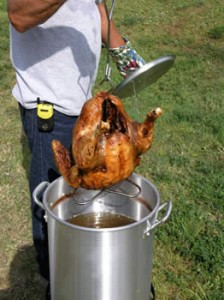
It’s that time of year again. The Thanksgiving holiday is upon us. As we’ve seen in the past few years, turkey fryers have gained in popularity as the way to cook a moist, delicious bird.
While there are a many turkey fryers on the market, most of them use gallons of oil. With the use of oil – particularly large amounts – combined with fire or heat, comes the chance you could start a fire or suffer serious burns.
In fact, turkey fryers are considered dangerous enough that Underwriters Laboratories (UL), the renowned independent, not-for-profit product safety testing and certification organization, refuses to certify any turkey fryers with its UL mark.
Even as manufacturers have designed turkey fryers with safety features including sturdier stands and non-heat conducting handles, UL maintains its position that fryers are a fire risk. “We’re worried by the increasing reports of fires related to turkey fryer use. Based on our test findings, the fryers used to produce those great-tasting birds are not worth the risks,” explains John Dregenberg, UL consumer affairs manager.
But regardless, every year 47 million turkeys are prepared for Thanksgiving day, and because of the attraction to the taste, and even the novelty, people will continue to use fryers.
Watch this demonstration from the Underwriters Laboratories to understand the risks associated with turkey fryers:
If fryers are overfilled with oil, the oil may splash out when the turkey is placed in the pot. The oil can then hit the burner or flames and cause a fire.
Placing a partially frozen turkey in the fryer can cause the oil to spill over the pot.
Most turkey fryers do not have thermostat controls. Because the heat is unregulated it can overheat and combust.
Lids and handles on turkey fryers become dangerously hot and may result in burns.
But if you still intend to use a fryer, regardless of the risks, UL offers some tips:
Always place a turkey fryer on a flat surface, outdoors, and away from buildings. Never use them in a garage, on a deck or in any other covered area.
Do not overfill the fryer, and make sure turkeys are completely thawed. The National Turkey Federation (NTF) recommendations say to thaw turkeys in the refrigerator for 24 hours for every five pounds.
Never leave a turkey fryer unattended.
When handling lids or touching the side of the pot, use insulated oven mitts. Safety googles are also recommended in case oil splatters.
Do not allow children or pets to come near the fryer, even hours after it has been in use as the oil remains hot for a long time.
Have an all-purpose fire extinguisher handy. If a fire does occur, don’t hesitate calling the fire department.
As an alternative, use one of the newer turkey cooking appliances that does not require oil.
Cook safely this Thanksgiving!
Next Steps:
Subscribe to our blog to receive the full blog series via email and stay informed about the latest security news and insight.
The flood waters may have receded and the ferocious winds may have dissipated, but if you’re not extra cautious Hurricane Sandy could still cause you some big headaches.
Although natural disasters like Hurricane Sandy bring out the best in people, they can also bring out the worst – in the form of scammers trying their best to separate you from your hard-earned cash.
The Better Businss Bureau calls these scamers “storm chasers” because they prey on the victims who need help cleaning up after a severe storm like Sandy. Some common rip-offs involve auto, home and/or yard repairs.
The Boston Better Business Bureau (BBB) has some tips to help you make the best decisions when it comes to making repairs and cleaning up. Read more →
https://www.americanalarm.com/wp-content/uploads/2022/12/American-Alarm_logo_1Xr.png00American Alarm Blogging Teamhttps://www.americanalarm.com/wp-content/uploads/2022/12/American-Alarm_logo_1Xr.pngAmerican Alarm Blogging Team2012-11-05 09:51:532026-01-26 10:07:07Home Security After Sandy: Beware of Scams
Although Hurricane Sandy may have lost some of its punch, its aftermath will be felt for some time to come.
On Monday, Hurricane Sandy wreaked havoc across the Northeast, with 85 mph winds, massive amounts of stinging rain and expansive flooding.
At 8 a.m. Tuesday morning, The Weather Channel reported that eight million people were without power. By the time the storm is over more than 60 million people could be affected by power outages, according to ABC News.
If you lose power and you’re using a portable gas generator, take precautions because using gas-powered equipment improperly can lead to carbon monoxide poisoning, warns the American Association of Poison Control Centers.
Widespread power outages produce a surge of alternative power/heating device usage, including generators, gas stoves, and charcoal or gas grills. Carbon monoxide (CO) production occurs any time fuels (oil, gas, kerosene, wood, propane and charcoal) are burned.
Enclosed spaces allow CO to build up quickly to dangerously high levels. You can’t see, taste or smell carbon monoxide, and it can cause life-threatening symptoms quickly in people. Even at moderate levels CO exposure can cause headaches, dizziness, confusion, fatigue and nausea. CO is called the “silent killer” because there are no odors and few symptoms that signal problems. People who are sleeping may never become aware of their symptoms and may pass away from carbon monoxide poisoning.
For those not affected by Hurricane Sandy, carbon monoxide poisoning is still an issue, particularly as we head into the heating season, and people face other circumstances requiring alternative heating sources. While CO poisoning cases increase following severe weather events, it still remains the most common cause of poisoning deaths in the United States.
The best way way to protect your family is with a monitored carbon monoxide detector. Watch this video for other top tips to keep your family safe from carbon monoxide poisoning.
Next Steps:
Subscribe to our blog to receive the full blog series via email and stay informed about the latest security news and insight.