Fighting Fire with Fire Alarms

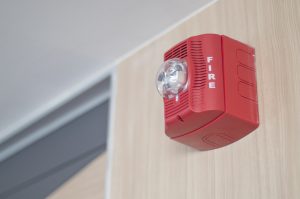
The passage of Fire Prevention Week offers an opportunity to re-evaluate our fire protection. Simply being aware of the risk is inadequate – alarm systems and procedures need to be in place for true fire safety.

As a FEMA press release about October being National Fire Protection Month notes, “most Americans underestimate their risk for fire, and many either lack emergency response plans – or fail to practice them with fire drills.”

FEMA also notes how in a typical house fire, there may be only one or two minutes after an alarm sounds to escape the premises. A small flame can become a major blaze in just 30 seconds. There isn’t a lot of room for delay once fire breaks out.

Read more

Protect Your Business During Fire Prevention Month

It’s National Fire Prevention Month through October — and a great time to evaluate your fire alarm system. These can be a key part of a holistic approach to protect your business, employees and customers.

Fire, unfortunately, remains a major risk to business owners here in New England and beyond. When a fire strikes, it may completely ruin your office, factory or retail shop. And if the fire doesn’t completely destroy your workplace, it can severely damage on-site gear and property. That can leave you unable to function properly for weeks or months — adding lost business to the price tag of the fire itself.

Read more

Fire Detection/Prevention: Getting the Alarm and Getting it Right

October 6 is Fire Prevention Week in North America, and it’s an appropriate occasion to think about how we can ensure our loved ones, homes, and property can be better protected. At American Alarm, we take the danger of fire especially seriously: A deadly fire’s aftermath was the reason why the company was launched.

Fire remains a very real threat in New England, and beyond. An alarm (preferably with a monitoring service) is a proven way of proactively detecting the presence of smoke before the fire is out of hand. For instance, this past September, an empty Waterford, Connecticut house was engulfed in flames before neighbors could report the blaze and the fire department could locate it.

Read more

5 Ways Seniors Can Prevent Falls: Stay Independent

October 1 will be the United Nations’ International Day of Older Persons. It’s an opportunity to consider our senior citizens and ensure they are as independent, safe and comfortable as possible.

Read more

Empty Nest with School in Session? Beware Burglars

Classes have started, and children are out of the house in New England. That means during regular business hours, your home is empty and more vulnerable to burglars than in the summer months.

Burglary is a serious problem. In 2017 — the most recent year with reliable statistics — some 1.4 million burglaries were committed across the United States, says the FBI. That’s about 18 percent of all property crimes committed in 2017.

The overall cost in property loss ran to about $3.4 billion, and the robbery of residential properties represented some 67 percent of all burglary crimes. Unfortunately, police only solve about 13 percent of burglary cases, Alarms.org reports.

Read more

School Vandalism is Costly: Security Systems Can Help

School is back in session, which means school vandalism unfortunately tends to rise accordingly. Surveillance and security solutions can help school administrators to deter or resolve such incidents.

School-related vandalism — a type of crime involving any damage or defacement of school property — is a real problem in Massachusetts and beyond. According to the Vandalism at School website, the annual price tag to remedy this kind of crime runs at around $8 billion nationally.

Read more

Restaurant Employees Take Big Bites of Their Companies’ Profits

New England’s small- and medium-sized restaurants (and other businesses) face a persistent internal problem: employee theft. Luckily, there are measures you can take to prevent it.

National statistics of employee-on-employer crime are sobering, according to a Forbes article. The U.S. Chamber of Commerce estimates that 75 percent of employees have stolen from their employers at least once. Companies with 150 employees or less are particularly vulnerable to internal financial or data theft, as well as other similar crimes.

The Chamber also determined that roughly 30 percent of business failures are caused by employee fraud and abuse. The toll of workplace thieving to the United States economy is some $50 billion annually, says a CNBC article (citing a statistic from Statistic Brain).

Cash on Tap in Restaurant Business

Because the bar and restaurant industry is often a cash business with few paper trails — one that relies heavily on people-intensive processes — there is an especially high risk of employee fraud and outright theft. There are many vulnerable points, from servers to wait staff, bartenders to kitchen help, all the way to the back office employees.

Read more

Parents with College Students: Protect Your Child’s Property

The fall semester is about to begin, bringing students into Boston and other New England venues. They’ll be fair game for thieves looking to make a quick profit.

These young students may be informal about security and less than diligent in securing their premises, and crooks respond accordingly. According to the National Center for Education Statistics (NCES), in 2016, there were 12,000 burglaries on-campus — which represents 42 percent of all criminal incidents on campuses or at post-secondary institutions.

Light Security = Student Thefts

Not that thieves must wait until fall classes are in session. Just last July, the Boston University newspaper noted a rash of fraternity house burglaries in Boston’s Kenmore Square area, near Boston University’s east campus. The thieves entered the occupants’ rooms in the frat houses and lifted bikes, laptops, wallets, a PlayStation and electronic gear. As the article explained, “The fraternity houses frequently sublet rooms during the summer months, and security can be lax.”

Students have a hard time with their finances without having to cope with robbery, too. Besides tuition and room and board, books and various school supplies alone can run students $1,168 annually, says a Forbes columnist. Factor in theft, and that can put a major hole in a young scholar’s budget — and the loss of a laptop can be an irreplaceable problem.

Read more

Security for the Health-Care World

In a perfect world, patients and health-care professionals could devote all of their time to the healing process. A variety of factors hinder that process in today’s health-care facilities,  most notably the opioid epidemic.

A recent Boston 25 News piece notes how Massachusetts Emergency Room nurses are particularly at risk. They face both physical and verbal abuse from opiate-intoxicated patients. A 2018 survey by the Massachusetts Nurses Association (MNA) notes that 69 percent of local nurses were assaulted by their patients during the prior two years.

This is just one area of vulnerability. Read more

Self-Checkout: Most Commonly Stolen Items

Gaps Plague Retail Self-Checkout Security

We know that self-supporting retail technology — with its sensors, devices and big data capabilities — offers us many conveniences. However, basic self-checkout platforms don’t always work well for retailers, here in New England, and beyond.

In fact, the Springfield, Massachusetts-based chain of stores Big Y World Class Markets decided it had to remove its self- checkout aisles, according to a Worcester Telegram.com article. In large part, this move was because of the higher incidence of thefts. The article notes that shoplifting is five times more likely at a self-checkout terminal than at a typical human-manned cash register. Read more