
Security You Can Trust
How Monitored Fire Alarms Help Firefighters Respond Faster
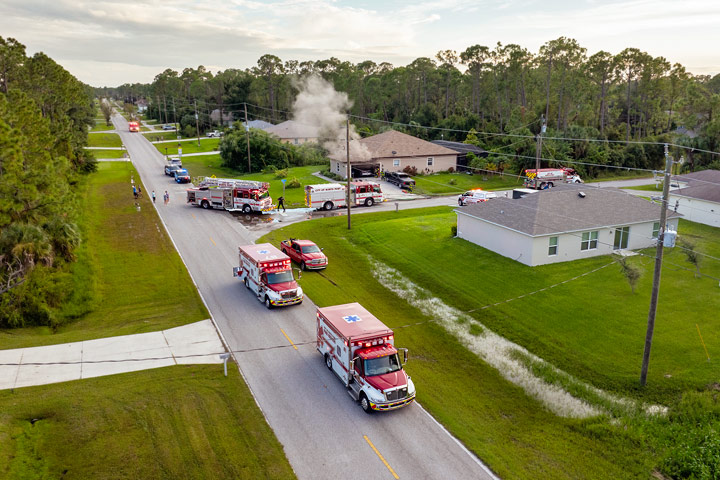 When there is a fire, every single second counts. The difference between a contained incident that doesn’t completely destroy your home and a total loss often comes down to one thing: how quickly firefighters were notified that there is an emergency. Every 60 seconds, a fire doubles in size, and within 3-5 minutes a small fire can engulf an entire room. Give it a few more minutes, and it will have already moved on to more.
How quickly fire department first responders are alerted and dispatched directly determines whether a fire is caught early enough to save your property. Professionally monitored fire systems are one of the only ways you can help make sure firefighters are alerted, and can give you the best chance at minimizing damage.
Reality of fire response times
A fire isn’t going to wait for someone to notice it, find their phone, and then call 911 so they can have a team on the way. Fire grows quickly, in the first 30 seconds a fire might go unnoticed since it’s still small and producing minimal smoke. By minute 5, fires become deadly. According to the U.S. Fire Administration “The public needs to understand that today’s structure fires can go from a small flame to flashover in just 3 to 5 minutes, leaving little time for escape” (USFA). Every minute of delay allows a fire to become more and more difficult for emergency services to deal with.
The average fire department response time, from dispatch to arrival should be less than 5 minutes (NFPA). But, this goal is from dispatch time, not fire start time. So, there is a critical gap with unmonitored alarms.
If there is someone in the building, you need to wait until they notice, which could bleed into those critical few minutes. It is worse if no one is in the building. A fire will grow unchecked until someone from outside discovers it, then response begins. With monitored alarm systems, a signal is transmitted to a monitoring center as soon as a fire alarm is triggered, and the fire department can be dispatched in just seconds.
How monitored fire alarms work
A monitored fire alarm system creates a direct link between the moment smoke is detected in your building and the moment that firefighters are dispatched. With a monitored alarm system, an alarm is triggered and transmits a signal to a monitoring center. Then, a trained operator reviews the alarm details and initiates a fire department dispatch so they are on their way quickly.
The reliability of communication is also critical. Monitored alarms should be equipped with backup communication channels, so that alarm signals always reach the monitoring center even when a fire damages internet or phone infrastructure. If power fails and all lines are cut, the signal is still able to get through. Since this is automated, this solves issues for buildings that might be left unoccupied for hours at a time. Even when nobody is home, you can rely on the system to alert a trained operator.
Why UL certification matters
Not all monitoring centers are created equal. UL certification is the gold standard that separates professionally operated monitoring centers from ones that might be less reliable.
UL (Underwriters Laboratories) is an independent safety science organization that will conduct inspections and audits of monitoring centers. They determine whether they meet UL 827 standards. This includes evaluating the facilities construction, power redundancies, communication infrastructure, staffing levels, operator training, signal processing times, record keeping, and disaster recovery planning.
UL standards are incredibly rigorous, they mandate that a monitoring center has maximum signal processing times so that nothing stays in a queue. They require adequate staffing depending on signal volume. UL requires redundant communication pathways and they require documentation of every single alarm signal that comes through with time stamps for every action taken.
Non-UL certified centers have no guaranteed standards for any of the above listed requirements. This means that your priority alarm signal could sit in queue, be handled poorly, or even fail to be transmitted during power outages. Ask your provider for their UL listing number and verify its validity.
When a fire breaks out, the timeline is unforgiving. Professionally monitored fire alarms help ensure that your home has help on the way as quickly as possible so that you, your family, and belongings are safe.
NEXT STEPS:
- Contact us today to learn more about security and surveillance.
- Learn more about what home and business security means to us.
- Subscribe to our blog to stay informed about the latest security news and insight.